
Our summary
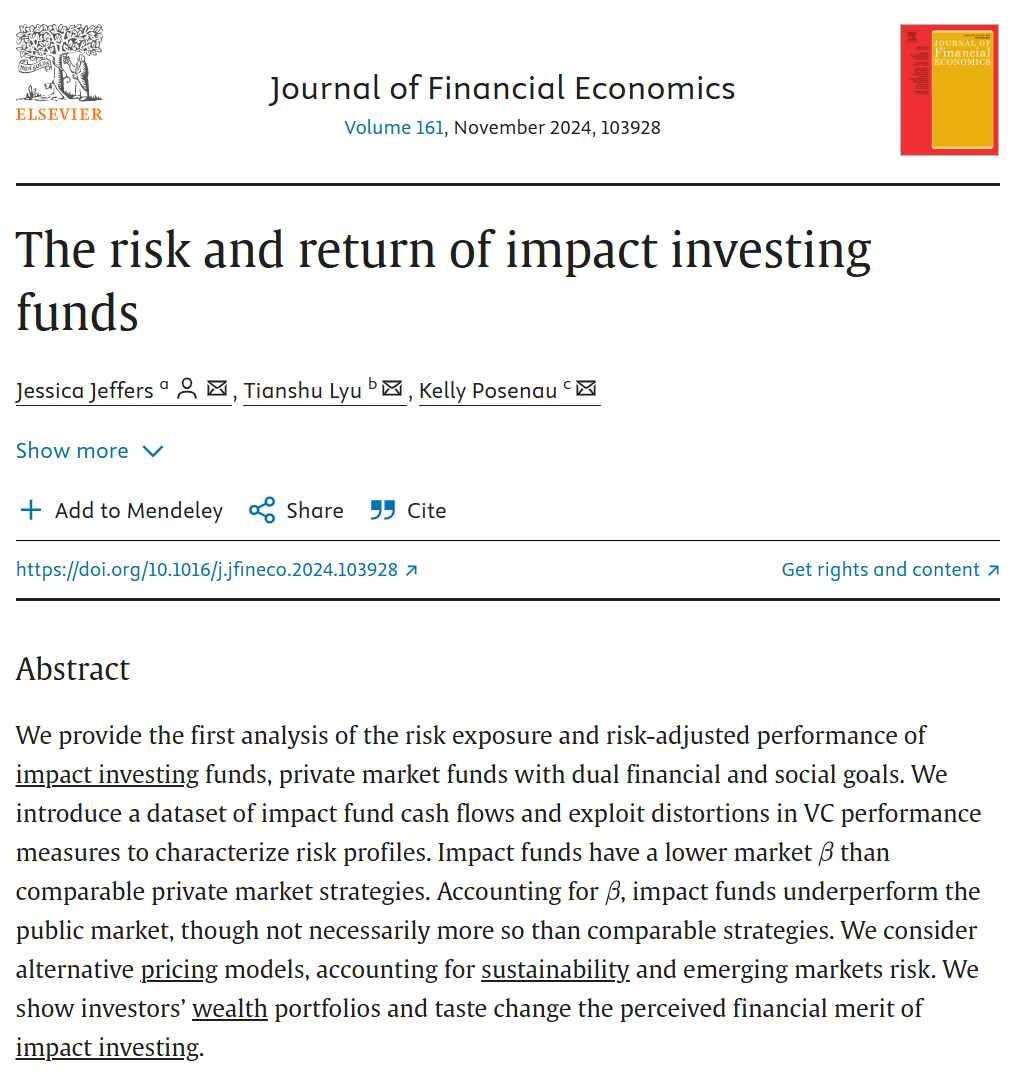
Jessica Jeffers, Tianshu Lyu and Kelly Posenau, Journal of Financial Economics, 2024

This paper is summarised by Mahdieh Vosough Gohari, who is finishing a PhD in Finance at BI Norwegian Business School. She specializes in impact investing, physical climate risk assessment, and ESG data and methodologies, with a focus on quantitative analysis. Mahdieh seeks to advance a deeper understanding of impact investing and its financial and real-world implications through knowledge sharing and data-driven analysis.
The report provides the first comprehensive analysis of risk exposureand risk-adjusted performance of private market impact investing funds. Using a new metric that infers systematic risk from private fund cash flows, the authors show that impact funds exhibit lower market beta than comparable non-impact private equity and venture capital funds.
While impact funds underperform public markets on a risk-adjusted basis, their underperformance is not significantly different from comparable private market strategies once market risk is properly accounted for. The results support a hedging interpretation of impact investing meaning that shifting from conventional private market investments to impact funds reduces portfolio market exposure. Importantly, the perceived financial concession of impact investing depends on investor preferences and wealth composition, particularly exposure to sustainability and emerging markets factors in this study, highlighting that the financial performance of impact investing is investor-specific rather than universally concessionary.
Key take aways
- Impact funds have lower market beta than comparable private equity and VC funds, reflecting lower exposure to market risk.
- Risk-adjusted return shows a smaller gap between impact and traditional funds’ performance, indicating that lower raw returns largely reflect reduced market risk.
- Long-short portfolio analysis suggests near-zero risk-adjusted differences between impact and benchmark funds, emphasizing that financial trade-offs are limited.
- Including impact funds can reduce overall portfolio market risk exposure for a well-diversified portfolio, reflecting the hedging potential of impact investing.
- Exposure to emerging markets is higher for impact funds, while sensitivity to public sustainability indices is relatively low, highlighting context-specific risk considerations.
Impact and Benchmark Funds
The primary focus of this study is impact funds which are selected based on three criteria: a clearly defined dual mandate to generate both financial returns and measurable impact, a market-rate seeking investment strategy, and the availability of detailed fund cash flow data. Impact funds’ risk and return are compared with a benchmark sample of traditional private equity funds matched by asset class, vintage year, and fund size. U.S. venture capital (VC) funds are included as an additional benchmark, given their importance and extensive documentation as a private market asset class.
Measuring Impact Investing Market β: PME Wedge
Because private funds have irregular cash flows, traditional beta measures do not accurately capture their market exposure. To address this, the authors introduce the Public Market Equivalent (PME) wedge, a new measure of private fund market risk. The PME wedge compares two metrics: a simple PME, which assumes the fund has one-to-one exposure to public equities (β = 1), and a generalized PME (GPME), which allows the fund’s beta to reflect its actual sensitivity to market movements. The difference between these two measures, the PME wedge, captures private funds’market exposure.
Main findings
Impact Funds Have Lower Market Exposure
Impact funds exhibit lower sensitivity to public equity market movements relative to comparable private equity or venture capital (VC) funds, the analysis shows. To illustrate this difference, the authors construct a hypothetical (non-replicable) long–short portfolio, taking a $1 long position in benchmark funds and a $1 short position in impact funds. They isolate the differences in market exposure of the two fund categories and confirm that impact funds contribute less market beta to a portfolio, consistent with a less cyclical investment strategy.
Risk Adjustment Narrows the Return Gap
While impact funds generally show lower raw returns than benchmarks, the authors show that much of this difference is explained by their lower market risk exposure. They find that, on a risk-adjusted basis, impact funds underperform public markets by approximately −$0.47 per $1 invested, compared with −$0.33 for matched private equity funds. The long-short portfolio analysis further shows near-zero risk-adjusted differences between impact and benchmark funds, indicating that the risk-adjusted financial trade-off associated with impact investing is smaller than raw returns suggest.
Sustainability and Additional Impact Investing Risk Factors
The authors further argue that the financial benefits of impact investing depend on the investor’s objectives and the composition of their overall portfolio. They find that impact funds generally exhibit low exposureto public sustainability indices, reflecting the highly targeted nature oftheir impact goals, which differ from broad ESG measures in public markets. At the same time, these funds show higher sensitivity to emerging market dynamics, indicating that they can increase risk for investors with pre-existing exposure to these markets. Consequently, the value of impact investing is context-specific, and understanding how a fund interacts with an investor’s alternative wealth portfolio is critical for assessing both its risk and return characteristics.
Implications
For limited partners (LPs), the study suggests that impact funds can serve as a portfolio diversifier by reducing exposure to market risk while also generating social and environmental outcomes. Risk-adjusted performance shows that the apparent return concession of impact investing largely reflects lower market beta, emphasizing the importance of considering fund risk profiles alongside raw returns. For general partners (GPs), clearly reporting risk characteristics can strengthen the financial credibility of impact strategies and attract more capital. And for prospective impact investors, a careful assessment of the distinctive risk–return profile of impact funds is central to determining how these strategies align with broader portfolio objectives and long-term goals.