
Our summary
By Brad M. Barber, Adair Morse and Ayako Yasuda, in the Journal of Financial Economics, 2021

This paper is summarised by Mahdieh Vosough Gohari, who is finishing a PhD in Finance at BI Norwegian Business School. She specializes in impact investing, physical climate risk assessment, and ESG data and methodologies, with a focus on quantitative analysis. Mahdieh seeks to advance a deeper understanding of impact investing and its financial and real-world implications through knowledge sharing and data-driven analysis.
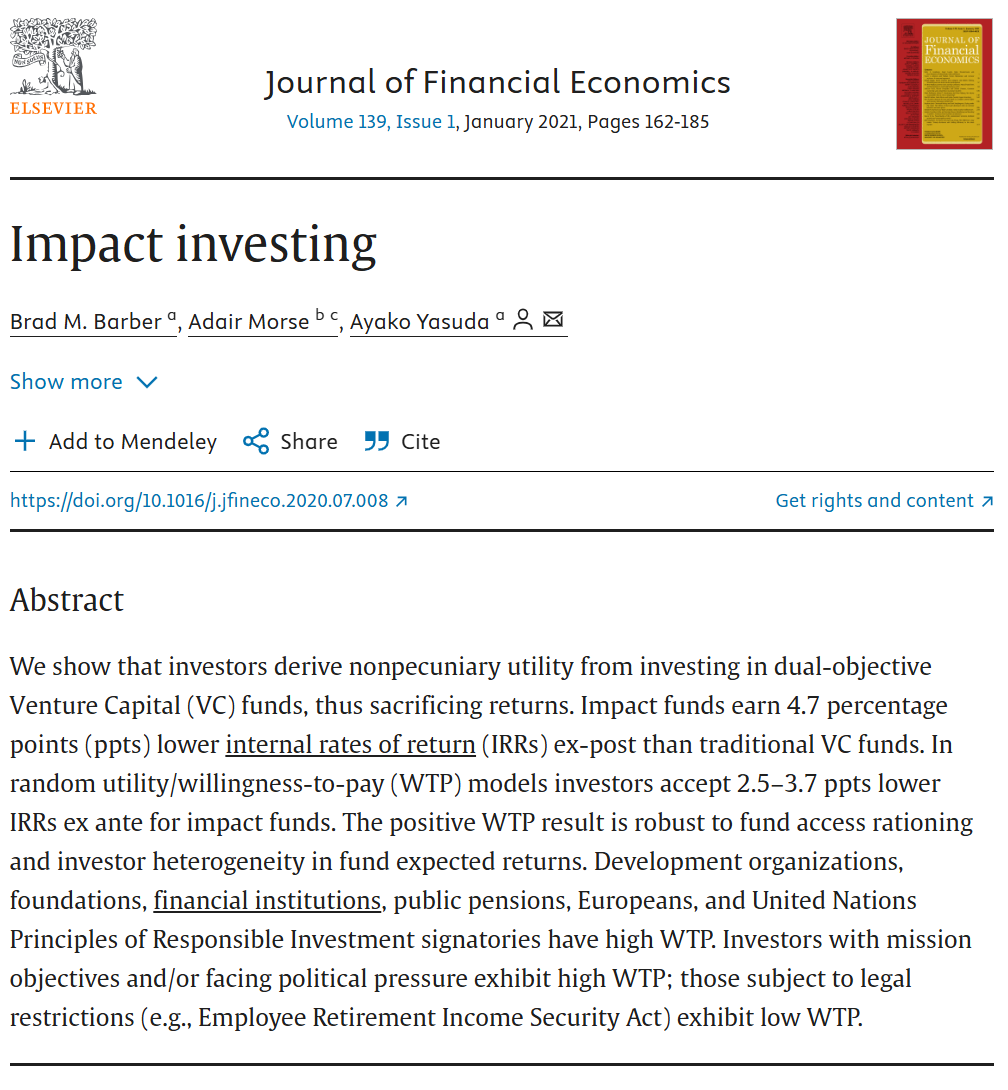
This study investigates whether investors are willing to trade financial returns for social and environmental impact in impact venture capital and growth funds. Using a willingness-to-pay (WTP) framework that captures ex-ante return expectations, Barber, Morse, and Yasuda show that limited partners knowingly accept lower expected financial returns when investing in impact funds.
They further show that this trade-off varies by investor type, geography, impact focus, and regulatory environment. The findings indicate that impact capital reflects stable, intentional preferences and that institutional and policy contexts play an important role in shaping the economic feasibility of dual-objective strategies.
Key takeaways
- Impact investors willingly forego 2.5%–3.7% in expected IRR (Internal Rate of Return) to pursue social or environmental impact.
- Willingness to pay is highest among development organizations, public pension funds, and financial institutions.
- LPs with prior impact fund experience are more likely to continue investing in similar strategies.
- Investors in Europe, Africa, Latin America, and Eastern Europe show stronger willingness to pay for impact.
- Supportive policies and institutional pressure encourage impact investing, while strict fiduciary rules can limit it.
- Environmental, poverty alleviation, and women or minority led investments carry the largest return trade-offs.
Introduction
Impact investing is a dual-objective strategy that aims to generate both financial returns and measurable social or environmental impact. In this strategy, investors derive utility not only from wealth creation, the traditional focus of finance, but also from achieving social or environmental goals. This raises a central question: are investors willing to pay for this impact? Barber, Morse, and Yasuda answer this question and explore how investor type, impact objectives, and regulatory context shape the trade-off between profit and purpose.
Analysis
Venture capitals (VC) and growth funds are the main focus of this paper, categorized as either traditional or impact funds. For all funds, data is collected on fund type, impact category, size, vintage, investor type, and expected returns.
The central contribution of the paper is its willingness-to-pay (WTP) framework. Instead of focusing solely on realized, ex-post returns such as IRRs or value multiples, Barber, Morse, and Yasuda examine what investors expect ex-ante when selecting impact funds. Their framework quantifies how much expected financial return limited partners (LPs) are willing to give up to generate social or environmental impact, given the available investment options. This approach moves beyond simple performance comparisons of funds and directly captures investor preferences.
Main findings
Investors Are Willing to Pay for Impact
The authors find that LPs do not simply end up with lower returns in impact funds, they knowingly accept them. Across their sample, impact investors are willing to forego 2.5%–3.7% in expected IRR to pursue impact strategies. This willingness holds even after accounting for differences in investment opportunities or expected performance.
Who Is Willing to Pay: Capital Source Matters
While impact LPs are generally willing to accept lower returns for impact, the authors observe that the degree of willingness varies across investor types. Development organizations, public pension funds, and financial institutions (such as banks and insurance companies) exhibit the highest willingness to trade profit for purpose, whereas private pension funds, wealth managers, endowments, and similar investors are less inclined to do so.
Their analysis also reveals persistence in investor behavior, showing that LPs who have previously allocated capital to impact funds are more likely to continue investing in similar strategies. This pattern suggests that impact investing reflects stable and intentional preferences rather than temporary experimentation or misperceptions.
Geography and Regulatory Environment
In addition to investor type, geography appears to be related to impact investing preferences, with investors in developed European countries, Africa, Latin America, and Eastern Europe, showing a stronger willingness to pay for impact. This geographic variation aligns with broader institutional differences, including stronger ESG integration in European markets and development focused mandates in emerging markets.
Moreover, the paper shows that institutional pressure and supportive policy frameworks can increase investors’ willingness to allocate capital to impact strategies. At the same time, strict interpretations of fiduciary duty that prioritize financial returns above all else can reduce demand for dual-mandate funds. In this sense, policy does not just regulate impact investing; it can shape its economic feasibility.
Not All Impact Is Equal
The authors find impact agenda as another factor related to investors’ willingnessto pay for impact. Investments targeting environmental impact, poverty alleviation, and support for women or minority led ventures carry the largest expected return trade-offs. These areas are closely linked to public goods and positive externalities, which likely elevate their perceived social value for investors. This suggests that the specific type of impact, rather than generally having an impact mandate, plays a critical role in investors’ preference.
Implications
For practitioners, the implications are clear. Impact capital reflects intentional investor preferences and comes with a measurable cost in terms of expected returns. Impact LPs explicitly balance financial and non-financial objectives, willingly accepting lower expected IRRs to achieve impact outcomes. For general partners, these findings underscore the importance of clearly defining impact objectives and aligning fund strategies with investor demand. And lastly for policymakers, the results show that regulatory design can influence capital allocation toward investments that generate social and environmental benefits.